I tout my blog as one that talks about love. It's been my mission to figure out what exactly love is... How do we get it? How do we give it? So first of all, it might be good to break it up into different kinds of love. For the record, I am not going to cheat and google these different kinds of love (yet). I'll just offer my opinions and I welcome you to comment and add your own thoughts.
Romantic Love - This is the type many of us think of first when we talk about love. It's the type that goes with lust and desire and sex. It's the type where you want to be together all the time. This type of love feels really, really good. It's usually what we mean when we say we're "in love."
Platonic Love - This is the type of love we have for our friends. This is pretty easy to give and find... you just have to give and receive support, find the good in people, listen, share, be vulnerable. This can get tricky because it might lead to confusion as to whether or not you're interested in romantic love. It's not too uncommon to move from Romantic Love to Platonic Love. That's when you hear (or say) the old "I love you, but I'm not 'in love' with you line." But it can go the other way, too. Sometimes platonic love can develop into romantic love.
Familial Love - This is the type of love you have for your siblings, parents, and maybe extended family... grandparents, aunts, uncles, cousins, nieces, nephews. You grew up with them and accept them regardless of their faults or quirks. You have absolutely NO romantic interest even if they're extremely attractive. (Tempted to make incest joke here, but I'll resist.) You feel like you can be truly yourself around them, though you can get on each others' nerves. You can often take this kind of love for granted because you trust it will never go away.
Love of Children - This is a love that's different and deeper than familial love. This is a protective love. Perhaps because it starts when a baby is completely dependent on us for care, this kind of love is usually given freely and unconditionally.
Love of God - This is a spiritual kind of love. It's about belief and faith and feeling that there is a higher power that will guide us. It's the kind of love we feel when we see beauty and goodness in the world.
Love of Pets - Sometimes this can almost be as strong as love of children, especially for people who don't have children. Again, it probably comes from caring for a living thing who is completely dependent on us and who loves us in return.
Love of Other Stuff - Though this may sound like a "materialistic" kind of love, I'm talking about when people say things like, "I love ice cream" or "I love summer" or "I love my house" or "I love my job." I think it's a positive thing to enjoy life and a good thing to love what we have. And when we lose something we loved... like a house or a job or even a treasured possession, we grieve.
Love of Self - This, of course, is very important. It may be hard to have any of the other kinds of love without tackling this one. This is the one in which we accept and embrace everything that's unique about us. We don't try to defend ourselves or pretend to be someone we're not. We know we're not perfect and that we have our faults, but we also celebrate our talents and want to share our gifts with others.
OK, that's all I can think of. Just thought I'd set that reference point so that in the future when I talk about "love" I can clarify the type I'm talking about.
Which of these types of loves do you have in your life right now? Is there a type you want but don't have? What can you do about that?
Showing posts with label unconditional love. Show all posts
Showing posts with label unconditional love. Show all posts
Wednesday, October 20, 2010


Tuesday, October 19, 2010
Why Do You Love Me? - An Answer for My Daughter
Twenty-six years ago today, I became a mother. That was a day my life changed. It's the day I learned of a love that's different and more powerful than any I'd ever experienced before.
My daughter and I have had many ups and downs since that day. We've had some very painful "discussions," especially during her teen years. Once, during one of those very heated "discussions," she told me she didn't love me. I told her that I was sad she felt that way, but that I knew she really did love me. I told her that some day she might feel bad that she'd said that to me, but that she shouldn't worry, because I know that even when she's mad at me, she loves me. (I'd remembered this speech from a scene in "Terms of Endearment"--a very moving conversation between dying Deborah Winger and her troubled son.)
I told my daughter that I'd loved her from the moment I knew I was pregnant and that I would always love her, no matter what she did, what she said, or even if she really didn't love me... even if she hated me. I still would love her with all my heart. She asked me with a stubborn defiance, "Why? Why do you love me, Mom?"
I thought of all the classic reasons. My daughter is model-quality beautiful, brilliant, and talented in every way. She is the only person I know who excels (and I mean top 1%) in everything she tries. Seriously! There is nothing she can't do, and I'm not just saying that because I'm her mother.
But that's not why I love her. Those may be reasons that the rest of the world loves her, but I know I'd love her just as much if none of those things were true. But why? Why do we love our children with such depth before they're even born? And then when they're born, that love just grows until our heart feels ready to burst, like the scene from "When the Grinch Stole Christmas". (Obviously, my post today is influenced by pop movies.)
I suppose part of that loves come from knowing that we are responsible for these innocent, beautiful babies. We witness this miracle...this tiny human being that grew within us and managed to find her way out into the world. And even though we've heard of all the biological explanations, we just know there is no way this could be possible unless there is a God.
And we look at this treasure God has bestowed us with and vow that we will be the perfect parent. We are determined to never let anyone harm this innocent baby. We read every parenting book and worry about every hiccup. We take care of this little miracle and marvel at his every move.
And as our little baby grows, we see that we've become her hero. We know how to get him to break into giggles. We know how to kiss away her tears. We feel his little head heavy on our shoulder as he snuggles close and drifts off to sleep. And we think, "I'm a good parent. I love this baby more than anything."
And then our babies grow up.
We start to see their unique characteristics. We see them struggle, make mistakes, and get hurt and, as much as we try, we realize we can't always kiss away their tears. We question whether we are the perfect parents we vowed we would be. We go from being their heroes to their embarrassing parents. We see them disagree with us as they work to establish their own ideas. We see them become independent as they grow into adulthood. We see them practicing their own traditions, making their own paths out in the world, finding love, living life, most of the time, without us. And we think, "My baby has grown up. I love her more than anything."
And then, one day, she has a baby of her own.
And finally, she understands the answer to her question.
My daughter and I have had many ups and downs since that day. We've had some very painful "discussions," especially during her teen years. Once, during one of those very heated "discussions," she told me she didn't love me. I told her that I was sad she felt that way, but that I knew she really did love me. I told her that some day she might feel bad that she'd said that to me, but that she shouldn't worry, because I know that even when she's mad at me, she loves me. (I'd remembered this speech from a scene in "Terms of Endearment"--a very moving conversation between dying Deborah Winger and her troubled son.)
I told my daughter that I'd loved her from the moment I knew I was pregnant and that I would always love her, no matter what she did, what she said, or even if she really didn't love me... even if she hated me. I still would love her with all my heart. She asked me with a stubborn defiance, "Why? Why do you love me, Mom?"
I thought of all the classic reasons. My daughter is model-quality beautiful, brilliant, and talented in every way. She is the only person I know who excels (and I mean top 1%) in everything she tries. Seriously! There is nothing she can't do, and I'm not just saying that because I'm her mother.
But that's not why I love her. Those may be reasons that the rest of the world loves her, but I know I'd love her just as much if none of those things were true. But why? Why do we love our children with such depth before they're even born? And then when they're born, that love just grows until our heart feels ready to burst, like the scene from "When the Grinch Stole Christmas". (Obviously, my post today is influenced by pop movies.)
I suppose part of that loves come from knowing that we are responsible for these innocent, beautiful babies. We witness this miracle...this tiny human being that grew within us and managed to find her way out into the world. And even though we've heard of all the biological explanations, we just know there is no way this could be possible unless there is a God.
And we look at this treasure God has bestowed us with and vow that we will be the perfect parent. We are determined to never let anyone harm this innocent baby. We read every parenting book and worry about every hiccup. We take care of this little miracle and marvel at his every move.
And as our little baby grows, we see that we've become her hero. We know how to get him to break into giggles. We know how to kiss away her tears. We feel his little head heavy on our shoulder as he snuggles close and drifts off to sleep. And we think, "I'm a good parent. I love this baby more than anything."
And then our babies grow up.
We start to see their unique characteristics. We see them struggle, make mistakes, and get hurt and, as much as we try, we realize we can't always kiss away their tears. We question whether we are the perfect parents we vowed we would be. We go from being their heroes to their embarrassing parents. We see them disagree with us as they work to establish their own ideas. We see them become independent as they grow into adulthood. We see them practicing their own traditions, making their own paths out in the world, finding love, living life, most of the time, without us. And we think, "My baby has grown up. I love her more than anything."
And then, one day, she has a baby of her own.
And finally, she understands the answer to her question.
Sunday, May 23, 2010
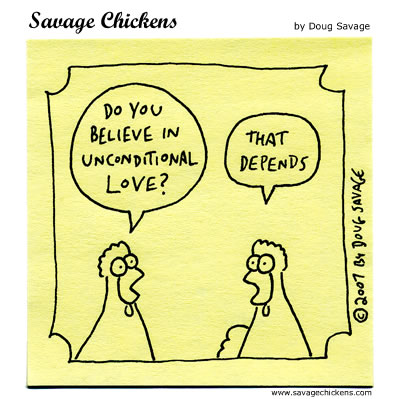
Unconditional Love
 As a "student of love," I am always checking the blogosphere for the latest, greatest information and came across this recent blog post in Psychology Today: Should Love Be Unconditional? This was written by Aaron Ben-Zeév, Ph.D., who is an expert on emotions and has written several books on the subject as well as the PT Blog, In the Name of Love.
I have to admit, this article was quite academic and a bit over my head. I had several, "Huh?" moments as reading. But, if I'm going to take my "Love Project" seriously, I have to do some serious research. Though, since I have a very hard time being serious and I prefer to write with a much-less academic style, I will take it upon myself to try and translate this article from academic to um... bloggy, with my own uneducated opinions about the content.
In the article, Ben-Zeev explains unconditional love as a love that is somewhat blind to reality and "is also unconditional in the sense of willingness to give everything to the beloved." He goes on to give a quote from a married woman who is in love with a married man... but, from what I can gather, the unconditional love that is being described is not with their spouses.
"He magnetizes all my thoughts, all my feelings, and he does it all the time. Our love does not depend on any external circumstance, nor can it ever be threatened by them, which is the whole miracle of it."
I'm guessing the "external circumstance" she's talking about is the complication of being married to someone else. I suppose this is to represent how this woman is "blind to reality." The problem I have is that I'm not thinking a person who got married to someone and is describing unconditional love with someone else is exactly an authority on unconditional love.
Ben-Zeev says: "Compromises, moderation, and boundaries are possible, and even necessary, when it comes to the implementation of love." He seems to be speaking out against the earlier definition of unconditional love (something I would call "blind love") as unhealthy. He then goes on to suggest we define unconditional love more as something which "endures despite unfavorable circumstances." Personally, that sounds more like a definition of commitment to me.
Ben-Zeev goes on to describe how people in love are not blind to their partners' faults, but just see more of a positive aspect, or love them in spite of their flaws. He wraps up by summarizing:
A lover might express: "Darling, my beloved beautiful partner, you are so precious to me and I easily see how wonderful you are; the small aspects in which you do not excel (to say the least) are so insignificant that there is no sense in dwelling upon them."
All very interesting, but not my idea of unconditional love. I think unconditional love is more like God's love or the type you have for your children... the type that says, "No matter how many times you roll your eyes at me and do all that other stuff that drives me crazy, I will always love you. I will love you, even if you don't love me. I would die for you." Is it possible between romantic partners? I suppose it is, but I don't know if it would be healthy.. especially the part about "I will love you, even if you don't love me." In romantic love, I believe the level of commitment has to be equal for the relationship to be healthy. So, if both people love each other unconditionally... well, they probably are saying something like:
"Darling, my beloved beautiful partner, you are so precious to me and I easily see how wonderful you are; we both have (rather big) aspects in which we do not excel, but that's what makes us human. Besides, we're getting old, and no one else will have us. Let's give this unconditional love thing a whirl. I'll love you forever and would die for you."
And then hope their partner doesn't kill them...
Subscribe to:
Posts (Atom)


 ShareThis

 Posts
Posts